
Reaction mechanism
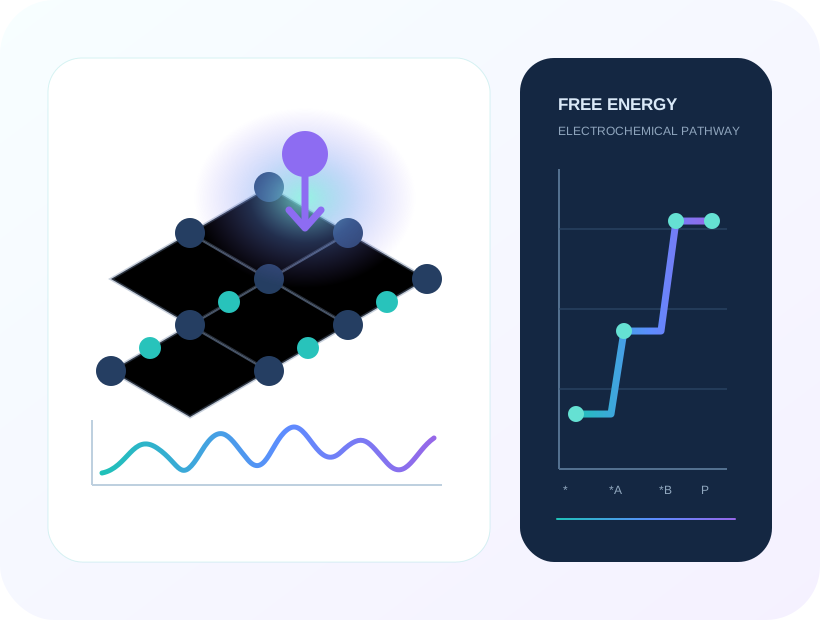
Compare adsorption structures, reaction intermediates, free energies, and barriers to identify favored pathways and rate-determining steps.
Connect experimental results to atomic-level mechanisms and the next materials design through DFT, electrochemistry, and interface modeling.
We build models around your experimental data and research goals, interpret electronic structures and reaction pathways, and recommend priorities for next experiments and material candidates.
Compare adsorption structures, reaction intermediates, free energies, and barriers to identify favored pathways and rate-determining steps.
Interpret the electronic origins of performance changes using DOS/PDOS, charge redistribution, and work functions.
Compare dopants, defects, interfaces, and candidate compositions to prioritize synthesis and follow-up experiments.
After assessing model feasibility, we confirm the scope, schedule, deliverables, and quotation for each project.
Explain experimentally observed differences between materials through stability, electronic structure, and charge transfer.
Connect adsorption energies and reaction free energies to experimental results to identify the origins of performance.
Compare dopants, defects, surfaces, and compositions to narrow down candidates for the next synthesis.
Iteratively improve computational predictions by connecting them to materials, electrochemical, and optical data.
Email us your research goals, current data, and required deliverables.